How to Check Property Ownership in Croatia: A Legal Guide for Foreign Buyers

If you are planning to buy property in Croatia, one of the most important steps you can take is to verify who actually owns the property before you commit to anything. In Croatia, property ownership is recorded in a public register known as the land register (zemljišna knjiga). Checking that register is not only possible — it is something every serious buyer should do as early as possible in the process.

The good news is that Croatia’s land registry system is publicly accessible, and basic ownership information can be checked online without special authorisation. The more important question, however, is not just how to access those records — it is what you are looking at once you open them, what the entries mean in legal terms, and which details can signal a problem that a non-lawyer might easily overlook.

This guide explains how to check property ownership in Croatia, what the land registry extract contains, what red flags to look for, and when professional legal review becomes essential. If you are considering a property purchase in Croatia, you may also find our broader guide on buying real estate in Croatia useful as additional context.

Why Checking Property Ownership in Croatia Matters

In Croatia, legal ownership of real estate is established through registration in the land register. This is not a technicality — it is a fundamental principle of Croatian property law. A person may have paid for a property, have possession of it, and use it on a daily basis, but if they are not registered as the owner in the land register, their legal title is not fully protected against third parties.

This means that when you buy property in Croatia, it is not enough to rely on what the seller tells you, what an agency presents to you, or what you see in the physical condition of the property. The land register is the authoritative source of legal truth about ownership, encumbrances, and restrictions affecting real estate in Croatia.

Checking property ownership before signing any contract or paying any deposit protects you against buying from someone who does not have full legal authority to sell, or against acquiring a property that is encumbered with debts, mortgages, or disputes that you did not know about.
Reviewing real estate documents before purchase — why checking property ownership in Croatia matters

Buying Property in Croatia?

Before you sign anything, have the ownership and encumbrances checked by a Zagreb-based property lawyer. A legal review at the start protects your investment from the risks that matter most.

The Croatian Land Registry: What It Is and How It Works

The land register in Croatia (zemljišna knjiga) is a public record maintained by the municipal courts and accessible through the judicial system. It records legal rights relating to real estate — primarily ownership, but also encumbrances, mortgages, easements, rights of use, and restrictions of various kinds.

Every property in Croatia that has been formally registered has a land registry file number (broj zemljišnoknjižnog uloška or ZU number). This file contains the legal history of the property: who has owned it, what rights were created on it, what has been transferred, and what burdens currently exist.

The land registry is separate from the cadastre (katastar), which is a spatial and administrative record maintained by the State Geodetic Administration. The cadastre deals with physical characteristics of land — size, location, type of use. The land registry deals with legal rights. Both matter in a property transaction, but they serve different purposes and should not be confused.
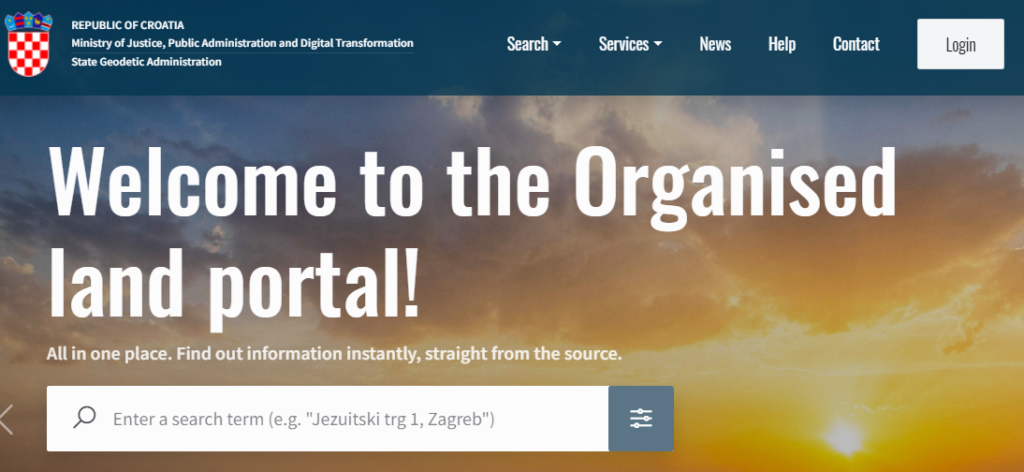
Official Croatian land registry and cadastre system interface for checking property ownership
Source: OSS Uređena zemlja (official portal)

How to Check Property Ownership in Croatia Online

Croatia maintains a publicly accessible online land registry system that allows anyone to search for property ownership records. The primary platform is the Organised Land Portal, operated jointly by the Ministry of Justice and the State Geodetic Administration.

Using the Organised Land Portal

The Organised Land Portal (Uređena zemlja) is available at oss.uredjenazemlja.hr and provides access to land registry extracts (zemljišnoknjižni izvadak) for registered properties across Croatia. The portal is publicly available — no account or registration is required to view records.

From the portal you can view property data online or request an official certified extract, which carries legal weight and may be required for formal transactions.

What You Need to Search

To find a specific property in the land registry, you will typically need one of the following: the land registry file number (ZU number) and the name of the cadastral municipality (katastarska općina) — this is the most direct search method. Alternatively, the cadastral parcel number (broj katastarske čestice) of the land on which the property sits. In some cases, an address search may work, though this is less reliable for rural or coastal properties where addressing can be inconsistent.

One important limitation worth noting: Croatian land registry records cannot be searched by the owner’s name. This means you cannot simply type in the seller’s name and see all properties they own. You must know the property identifier to find its records.

Understanding the Land Registry Extract

Once you locate the property, you will see the land registry extract (ZK izvadak). This document is divided into three parts, each of which tells you something different and important about the property.
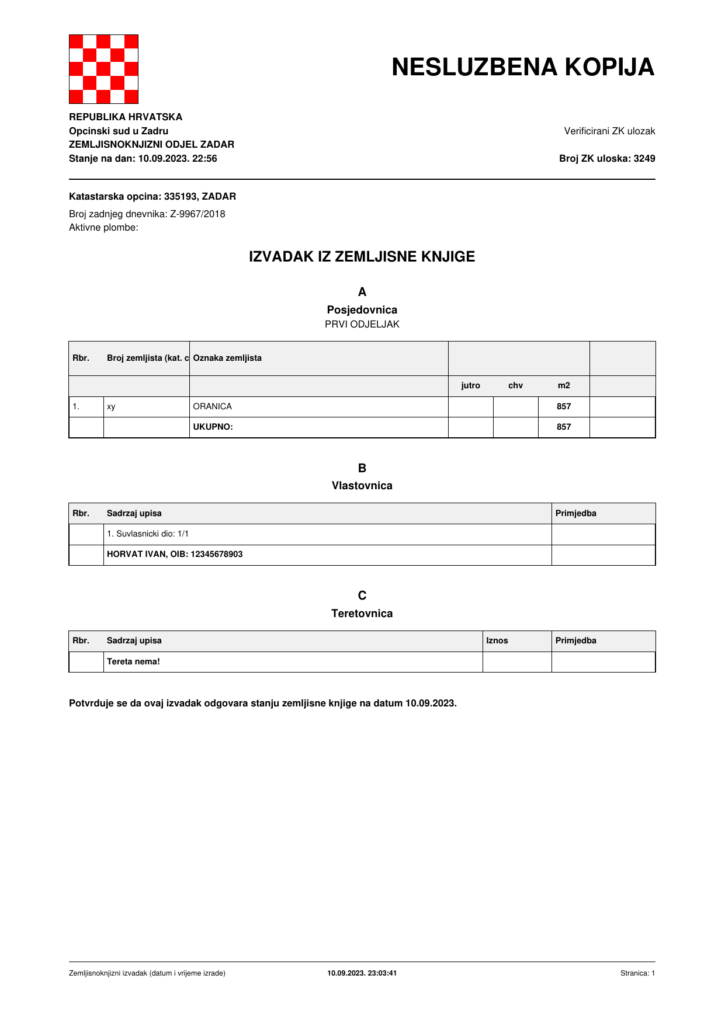
Sample Croatian land registry extract (ZK izvadak) showing property description, ownership in Sheet B and no encumbrances in Sheet C
An example of a Croatian land registry extract (zemljišnoknjižni izvadak). Sheet A describes the property, Sheet B confirms the registered owner, and Sheet C shows whether any encumbrances such as mortgages exist. This extract shows “Tereta nema” — no encumbrances registered.

Sheet A — Property Description

Sheet A contains the physical description of the property: the cadastral plot number, the surface area, the address or location, the type of land or use classification, and the connection to related cadastral data. This sheet tells you what the property legally is — its dimensions, designation, and physical identification.

A discrepancy between what Sheet A describes and the actual physical situation of the property on the ground — for example, a different surface area or a building not recorded — is a warning sign that deserves closer attention.

Sheet B — Ownership

Sheet B records who legally owns the property and in what capacity. This is the most directly relevant sheet for a buyer: it tells you whether the seller is actually the registered owner, whether they own the property outright or as a co-owner, and whether there are any restrictions on their right to dispose of the property.

Common entries in Sheet B that require careful attention include: ownership held by multiple co-owners, ownership restricted by a right of pre-emption (pravo prvokupa), a notation of pending succession proceedings, or any restriction on the owner’s capacity to transfer the property independently.

Sheet C — Encumbrances

Sheet C records all rights and burdens affecting the property that are held by third parties. This includes mortgages and pledges, easements, rights of use, enforcement proceedings, notations of pending disputes, and any other registered charge or restriction.

Sheet C is often the most complex part of the extract and the one where the most serious issues arise. A mortgage that has not been released, an active enforcement proceeding, or a registered dispute can all create significant problems for a buyer if they are not identified and addressed before the transaction is completed.

Land Registry vs. Cadastre: What Is the Difference and Why It Matters

Many buyers — and even some agents — use the terms land registry and cadastre interchangeably. They are two different systems with different purposes, and the distinction is practically important.

The land registry (zemljišna knjiga) is a legal record. It establishes and confirms legal rights — ownership, mortgages, easements, and other interests. What is recorded in the land registry is presumed to be legally correct and can be relied on by third parties acting in good faith.

The cadastre (katastar) is a spatial and administrative record. It records the physical characteristics of land: parcel boundaries, surface area, category of use, and connection to coordinates. It does not establish legal ownership. The cadastre may show an outdated name as the registered user of land, but this is not the same as legal ownership.

In an ideal situation, the land registry and the cadastre are aligned and consistent with the physical reality of the property. In practice, discrepancies exist — sometimes because the records have not been updated after transactions, inheritance, or construction. Identifying and resolving these discrepancies before purchase is part of proper legal due diligence.

Legal review of property ownership records — identifying red flags in Croatia land registry before purchase

What Red Flags to Look for When Checking Property Ownership in Croatia

Knowing how to access the land registry is only the first step. The more important skill is knowing what to look for once you have the extract open. The following are the most common warning signs that should prompt further legal review before any commitment is made.

The Seller Is Not the Sole Registered Owner

If the property is registered in the name of multiple co-owners — which is common after inheritance — the seller may not have the authority to sell the property on their own. In Croatia, selling co-owned property generally requires the agreement of all co-owners. A seller who says they can sell without involving the other co-owners may be mistaken or misleading, and proceeding on that basis can create serious legal complications.

Unresolved Succession Proceedings

A common issue in Croatian real estate is that properties change hands through inheritance but the land registry is never updated. The property remains in the name of a deceased person, while the heirs sell it informally. In such situations, the legal succession must be formally completed and the land registry updated before a valid transfer can take place. A property where the registered owner is deceased is not ready to be purchased without first resolving the succession.

Active Mortgages or Liens

If Sheet C shows an active mortgage, pledge, or enforcement notation, the property is encumbered. Buying an encumbered property without ensuring that the encumbrance is cleared as part of the transaction — or properly coordinated with the lender — means you may acquire the property together with the debt. This is one of the most serious risks in Croatian property transactions and one of the most common.

Enforcement or Dispute Notations

Sheet C may also show entries relating to enforcement proceedings against the seller, injunctions, or notations of ongoing legal disputes. These entries indicate that the property is caught up in legal proceedings that could affect the buyer’s ability to acquire clear title. Transactions involving properties with active enforcement notations require very careful legal management.

Co-ownership Pre-emption Rights

Where the property is co-owned, the other co-owners may have a statutory right of first refusal (pravo prvokupa) before the property can be sold to a third party. If this right exists and is not properly addressed, the sale to you as a buyer may be challengeable after the fact.

Discrepancies Between Registry and Physical Reality

If what the extract describes does not match what you see or what the seller represents — in terms of size, extent, boundaries, or the nature of what is built on the land — this should be investigated carefully. Unauthorised construction, informal extensions, or unregistered changes all create legal uncertainty that affects what you are actually buying. Our Civil Law services cover how we approach these issues in the context of a full due diligence review.

Found Something in the Land Registry You Are Not Sure About?

We can tell you what it means and whether it is a problem. A quick legal review before you commit is far less costly than resolving an issue after signing.

Can You Verify Property Ownership in Croatia Without Visiting?

Yes. Because the land registry is publicly accessible online, it is entirely possible to run an initial ownership check remotely, from anywhere in the world, as long as you have the property’s land registry file number or cadastral parcel number.

This makes the first-level check straightforward for international buyers. However, there is an important practical limitation: finding the right property identifier in the first place can itself require local knowledge, particularly for older properties, rural land, or coastal areas where the administrative records may be less straightforward to navigate.

More importantly, reading and interpreting the extract correctly — understanding what each entry means, what the legal implications are, and whether the situation is normal or concerning — typically requires legal expertise. This is where working with a property lawyer in Croatia adds direct, practical value for a foreign buyer.

What a Land Registry Check Tells You — and What It Does Not

A land registry check is a powerful and important tool, but it is not a complete picture of the property’s legal situation on its own.

It tells you who the registered owner is, what encumbrances formally exist, whether there are any active enforcement or dispute notations, and what the official description of the property is. All of this is legally important and can prevent you from making obvious mistakes.

What a land registry check does not tell you includes: whether the building itself was constructed with the required permits, whether there are any informal arrangements or agreements affecting the property that have not been registered, whether the seller has tax liabilities relating to the property, whether there are any boundary disputes or neighbour issues that exist in practice but are not formally recorded, or whether the property’s current use is consistent with its legal designation.

A thorough legal due diligence review covers these dimensions beyond what the land registry alone can show. For buyers making a significant investment, that broader review is what separates a well-protected transaction from one that carries hidden risk.

When a Self-Check Is Not Enough: The Role of a Property Lawyer

Running a land registry check yourself is a reasonable and recommended first step. But there is an important difference between reading the records and understanding what they mean for your specific transaction.

A property lawyer reviewing the same extract is looking for things that a buyer without legal training may not recognise as significant. An entry that appears routine may indicate a legal restriction with practical consequences. A notation that looks like a formality may signal an active dispute. An encumbrance that appears outdated may still be legally effective until it is formally released.

Beyond the extract itself, a property lawyer in Croatia can verify the position with reference to additional public records, identify inconsistencies across the land registry, cadastre, and building permit system, structure the transaction to ensure the encumbrances are dealt with correctly, and ensure that the purchase contract is drafted in a way that protects you if anything turns out to be different from what was represented. Our Legal Services page provides more detail on how we support buyers through the full process.

How Kontić Legal Can Help

Kontić Legal is a Zagreb-based law office providing legal support to domestic and international clients on real estate transactions in Croatia. We assist buyers at every stage of the process — from the first ownership check through to final land registry registration.

Our property due diligence service covers a full review of the land registry position, cadastral situation, building legality, permit status, ownership history, and any encumbrances or restrictions relevant to the property. We identify issues before you commit, not after.

We work with Croatian and international buyers, and we are equipped to manage transactions remotely through a power of attorney. Whether you are buying an apartment in Zagreb, a coastal property, or a commercial real estate asset, we provide the legal review and transaction management your purchase requires. You can read more about our firm on our About Us page.

Frequently Asked Questions

  • How do I check property ownership in Croatia?

    You can check property ownership in Croatia through the Organised Land Portal at oss.uredjenazemlja.hr. You will need the land registry file number (ZU number) and the name of the cadastral municipality. The portal is publicly accessible and does not require registration. For a certified official extract, you can request one through the same portal for a small fee.

  • Is the Croatian land registry publicly accessible?

    Yes. The Croatian land registry is a public register and anyone is entitled to access it, whether online or directly at the relevant municipal court. No special interest or authorisation is required. This applies equally to Croatian citizens and foreign nationals.

  • What does a land registry extract show in Croatia?

    A Croatian land registry extract is divided into three sheets. Sheet A describes the property — its location, size, and classification. Sheet B shows who the registered owner is and any restrictions on their right to dispose of the property. Sheet C lists encumbrances, including mortgages, easements, enforcement notations, and registered disputes.

  • Can I search for property by owner’s name in Croatia?

    No. Croatian land registry records cannot be searched by the owner’s name. You must know the land registry file number or the cadastral parcel number and cadastral municipality to find a specific property. This is one reason why identifying the correct property identifier is an important first step.

  • What is the difference between the land registry and the cadastre in Croatia?

    The land registry (zemljišna knjiga) is a legal record establishing ownership and other rights. The cadastre (katastar) is a spatial record describing the physical characteristics of land. They are separate systems. The land registry is the authoritative source for legal ownership in Croatia. The cadastre provides supporting physical data but does not establish title.

  • Do I need a lawyer to check property ownership in Croatia?

    You do not need a lawyer to access the online land registry portal. However, correctly interpreting what you find — particularly if there are encumbrances, co-ownership issues, or succession-related entries — typically requires legal expertise. For any serious purchase, having a property lawyer review the full registry position before you commit is strongly advisable.

  • What if the property in Croatia has an active mortgage?

    An active mortgage appears in Sheet C of the land registry extract. This does not automatically prevent a sale, but it means the mortgage must be released as part of the transaction — usually from the purchase price proceeds. This requires careful legal structuring to ensure the buyer does not acquire the property while the mortgage remains active against it.

  • Can I verify property ownership in Croatia from abroad?

    Yes. The online land registry portal is accessible internationally. However, interpreting the results, identifying the correct property identifiers, and managing the legal review of a purchase remotely is best handled with professional legal support. Many foreign buyers complete property transactions in Croatia through a lawyer acting under a power of attorney.

Contact a Property Lawyer in Zagreb

If you are in the process of buying property in Croatia and want to verify ownership, check for encumbrances, or have the full legal position reviewed before you sign anything, Kontić Legal is ready to assist.

We provide targeted legal due diligence, full transaction support, and clear advice tailored to your specific property and situation. Whether you are at the early research stage or already in negotiation, the right time to involve a lawyer is before you commit — not after.

Contact Kontić Legal today to discuss your property and arrange a legal review.


Buying Real Estate in Croatia

Buying real estate in Croatia is becoming increasingly attractive to foreign buyers, investors, families relocating to the EU, and professionals looking for a second home or long-term base. Whether you want to buy an apartment in Zagreb, invest in a rental property on the Croatian coast, or acquire a holiday home, the transaction should be approached with careful legal planning from the outset.

Croatia offers a stable legal framework, EU membership, and strong lifestyle appeal. At the same time, property transactions in Croatia still require close attention to ownership records, land registry entries, building legality, tax treatment, and transaction structure. A property may look ideal in practice, but unresolved legal issues can create serious problems after signing if they are not identified in time.

For that reason, buying real estate in Croatia should never be treated as a simple administrative step. It is a legal transaction that should be reviewed properly before money changes hands.

At Kontić Legal, a Zagreb-based real estate law office, we assist domestic and international clients with property purchases across Croatia. We support buyers through the full process, including legal due diligence, contract drafting and review, negotiation support, land registry registration, and remote representation by power of attorney where needed. You can learn more about our full range of services on our Legal Services page.

Why Buying Real Estate in Croatia Is Attractive

Croatia continues to attract interest from foreign buyers for several reasons. It combines legal certainty as an EU Member State with a desirable lifestyle, tourism potential, and a market that still offers opportunities across different regions and property types.

Some buyers are looking for a home for personal use. Others are focused on investment, relocation, or future residence planning. Zagreb remains attractive for buyers seeking year-round use, stronger long-term rental demand, and access to business infrastructure. Coastal areas remain popular for holiday homes, seasonal rentals, and lifestyle-driven purchases.

For many international clients, the decision is not only about buying property. It is also connected with broader questions such as relocation, temporary residence in Croatia, family planning, or setting up a Croatian company for investment purposes.

Zagreb city centre — why foreign buyers choose Croatia for real estate investment

Can Foreigners Buy Real Estate in Croatia?

Yes, foreigners can buy real estate in Croatia, but the legal route depends on the buyer’s nationality and on the type of property involved.

EU and EEA citizens are generally in a position comparable to Croatian citizens when purchasing most types of real estate in Croatia. For third-country nationals, the situation is more nuanced and usually depends on reciprocity rules and, in many cases, prior approval from the competent Croatian ministry. Agricultural land, forest land, and certain other categories may be subject to additional restrictions or special rules.

This is one of the first points that should be checked before the transaction moves forward. Buyers often focus on the property itself and only later discover that their nationality or the property classification affects the purchase structure or timeline.

Buying an Apartment in Zagreb vs Buying Coastal Property

Buying an Apartment in Zagreb

For many foreign buyers, Zagreb is the most practical entry point into the Croatian property market. It offers year-round infrastructure, international schools, business activity, and a more stable rental market than highly seasonal locations.

A buyer looking to buy an apartment in Zagreb is often motivated by one of four goals: personal relocation, investment for long-term rental income, a future residence base, or family use.

From a legal and practical perspective, Zagreb transactions are often easier to manage because documentation, administrative access, and professional coordination can be more straightforward. That does not mean the purchase is risk-free. Urban planning status, ownership history, condominium documentation, and building legality still need to be reviewed carefully.

Buying Property on the Coast

Coastal property in Croatia attracts buyers interested in holiday use, tourism potential, and long-term capital appreciation. However, coastal transactions can carry additional complexity. The legal history of the property, use permits, historic construction, access rights, and short-term rental expectations all need to be checked carefully.

In premium locations, buyers are often emotionally attached to a property before the legal review is complete. That is precisely why legal due diligence should be carried out before commitment, not after.

Is It Safe to Buy Property in Croatia?

Yes, buying property in Croatia can be safe — but only if the transaction is properly structured and legally reviewed.

Many buyers are not asking whether a purchase is legally possible. They are asking whether it is safe. The answer depends entirely on whether the buyer verifies ownership, checks encumbrances, reviews permits, and ensures the contract and registration process are handled correctly.

A safe purchase is not the result of optimism. It is the result of legal preparation.

Thinking About Buying Property in Croatia?

Our Zagreb-based property lawyers help foreign buyers navigate the full legal process — from due diligence and contract review to land registry registration. Get clear legal guidance before you commit.

Property purchase agreement documents — step-by-step legal process for buying real estate in Croatia

Step-by-Step Guide to Buying Real Estate in Croatia

1. Identify the Property and Basic Deal Terms

The process usually starts with the buyer identifying a property and discussing the main commercial terms with the seller or the agency. At this stage, buyers often receive only partial information. That information may be useful, but it should not be treated as a substitute for legal review.

Before paying a reservation fee, deposit, or any part of the purchase price, the legal status of the property should be checked.

2. Obtain the Buyer’s OIB

In practice, a buyer will usually need a Croatian personal identification number, known as an OIB, to proceed with the transaction and related administrative steps. OIB is also commonly required in broader legal and administrative processes in Croatia.

3. Carry Out Legal Due Diligence

This is the most important stage of the entire process.

Legal due diligence in a Croatian real estate transaction typically includes review of: ownership and title, land registry status, encumbrances such as mortgages, easements, or liens, co-ownership issues, construction legality and use permits where relevant, and alignment between land registry and factual or cadastral situation.

4. Sign a Pre-Contract if Needed

Some transactions include a pre-contract and a deposit. In others, the parties move directly to the main sale and purchase agreement.

Whether a pre-contract is advisable depends on the state of documentation, the timing of payment, and whether certain conditions still need to be fulfilled before closing. A pre-contract should never be signed casually. If it is poorly drafted, it can create unnecessary exposure or disputes about payment, deadlines, or default.

5. Prepare and Sign the Sale and Purchase Agreement

The sale and purchase agreement must clearly regulate the parties, the property, the purchase price, the payment structure, the seller’s registration consent, possession handover, tax matters, and any special conditions.

Under Croatian practice, notarization of the seller’s signature is generally relevant for registration purposes.

The agreement should not be treated as a template document. It should reflect the specific property, transaction risks, and buyer protections required in that case.

6. Pay the Purchase Price Securely

The way the purchase price is paid matters. In some cases, payment can be made directly. In others, the payment structure should be phased or conditional.

A buyer should not focus only on the amount being paid, but also on when and under what conditions payment is released. This becomes especially important where title issues, seller obligations, or registration timing need to be coordinated carefully.

7. Register Ownership in the Land Register

In Croatia, signing the contract is not the final legal step. The goal is registration of ownership in the land register.

This is a key point that many non-lawyers misunderstand. A signed contract without proper registration does not provide the same legal position as a completed and registered transfer.

Common Legal Risks When Buying Property in Croatia

Unclear Ownership

The person selling the property may not be the sole registered owner, or their ownership rights may be limited, disputed, or connected with unresolved succession or co-ownership issues.

Mortgages and Other Encumbrances

Even where the property appears commercially attractive, the land register may show mortgages, easements, rights of use, enforcement notations, or other burdens that affect value or use.

Building Legality Problems

Construction legality is one of the most sensitive issues in Croatian property transactions. The property may physically exist, but that does not automatically mean that all relevant permits and legal requirements have been satisfied.

Land Registry and Factual Discrepancies

The records may not fully reflect the factual situation on the ground. This can affect boundaries, use, unit designation, or the legal description of what is actually being sold.

Poorly Structured Contracts

A generic contract may fail to protect the buyer on timing, payment, warranties, registration consent, possession, or remedies if something goes wrong. See our Civil Law services for how we approach contract protection for property buyers.

Legal review of property documents — identifying risks before buying real estate in Croatia

Not Sure What Legal Risks Apply to Your Property?

Before you sign anything, speak with a property lawyer who knows exactly what to check — and how to protect you if something is wrong.

Property Lawyer Croatia: Why Legal Representation Matters

If you are searching for a property lawyer in Croatia, the real question is not whether a lawyer is useful. It is what risks your lawyer is supposed to identify and prevent before the transaction becomes irreversible.

A property lawyer in Croatia should not merely review the final agreement. Proper legal support should begin earlier and include due diligence, transaction structuring, issue spotting, drafting, and management of the registration process.

This is especially important for foreign buyers who may not know how Croatian land registry practice works, what documents matter most, which risks are common in practice, or how to structure the deal when buying remotely.

Real Estate Lawyer Zagreb: Why Local Expertise Helps

If you plan to buy an apartment in Zagreb or need legal coordination from Croatia’s capital, working with a real estate lawyer in Zagreb offers practical advantages.

A Zagreb-based law office like Kontić Legal is better positioned to coordinate efficiently with notaries, sellers, agents, public authorities, and land registry processes connected with the transaction.

This matters both for efficiency and for credibility. Buyers want a lawyer who can explain the law clearly, manage the documents practically, and move the process forward without avoidable delays.

Taxes and Costs When Buying Real Estate in Croatia

Buyers should budget not only for the purchase price, but also for the full transaction cost.

In most transactions involving existing (resale) property, the buyer is required to pay real estate transfer tax at a rate of 3% of the property’s market value. This tax is typically the main fiscal cost and is assessed by the Croatian Tax Administration, which may determine the market value independently of the agreed purchase price.

However, in certain transactions, VAT applies instead of transfer tax. This is usually the case when purchasing newly built property from a developer or in transactions involving sellers within the VAT system. In such situations, VAT (generally included in the purchase price) replaces the 3% transfer tax.

Importantly, these two taxes do not apply simultaneously — either transfer tax or VAT applies, but not both.

In addition to tax, a buyer should consider: legal fees, notary-related costs, registration-related costs, translation or certification costs if foreign documents are involved, and agency commission if applicable.

The correct tax treatment should always be verified with a licensed tax advisor. The applicable legal and tax framework may differ depending on whether the seller is a private individual, a developer, or a company.

Buying Property Through a Croatian Company

Some investors consider buying property through a Croatian company rather than in their personal name.

This can be relevant where the purchase is part of a broader investment project, business activity, rental structure, or future resale strategy. It is not automatically the better route, but it may be worth assessing where the buyer is acting with a commercial objective.

However, this route also introduces additional legal, tax, and compliance considerations. The overall structure should therefore be carefully assessed in light of the specific investment goals, ownership structure, and exit strategy.

If you are considering this approach, it is important to evaluate both the real estate and corporate aspects of the transaction together. You can find more information on our Company Formation in Croatia page, as well as within our broader Business Law services section.

Residency and Property Ownership in Croatia

Buying property in Croatia does not automatically grant residence rights. However, for many clients, property ownership forms part of a broader relocation plan involving residence options, family planning, or long-term presence in Croatia.

Depending on your circumstances, there are several residence options that may be relevant alongside a property purchase. These can include temporary stay for specific purposes, residence based on remote work (Digital Nomad), family reunification, or other residence pathways depending on your status and plans.

Croatia offers a dedicated framework for remote workers under the Digital Nomad residence scheme, which allows non-EU nationals to stay in Croatia while working for a foreign employer or business. This option is often considered by buyers who wish to combine property ownership with a flexible stay arrangement.

If your intention is to spend more time in Croatia after purchasing property, it is important to plan both aspects together. A coordinated approach ensures that your residence status, address registration, and overall legal position are aligned from the outset.

Can You Buy Real Estate in Croatia Remotely?

Yes, in many cases you can buy real estate in Croatia remotely through a properly issued power of attorney.

This is especially useful for international buyers who do not want to travel repeatedly for every stage of the transaction. Remote purchasing can work very well, but only if the transaction documents, authority scope, and practical coordination are handled correctly from the beginning.

How Long Does It Take to Buy Property in Croatia?

There is no single timeline for every case. A straightforward purchase may move relatively quickly, while more complex transactions can take longer because of documentation issues, financing, ministry approval, seller-side delays, or registration timing.

What matters more than speed is proper sequencing. In practice, many of the worst property problems arise when parties rush to sign before the legal review is finished.

Why Choose Kontić Legal

Kontić Legal is a Zagreb-based law office advising both Croatian and international clients on real estate and business-related matters. You can read more about our firm and approach on our About Us page.

Our approach is practical and protective. We do not treat a property purchase as a formality. We treat it as a legal transaction that deserves careful review, clear drafting, and a structure that protects the buyer from avoidable risk.

We assist clients with full legal due diligence, review of ownership and encumbrances, contract drafting and negotiation, secure transaction planning, land registry registration, remote representation by power of attorney, and coordination with the wider legal and administrative steps surrounding the purchase. Visit our Legal Services page for a full overview of how we work.

Property lawyer consultation in Zagreb — Kontić Legal real estate legal services Croatia

Frequently Asked Questions

  • Can foreigners buy real estate in Croatia?

    Yes, but the legal route depends on nationality and on the property type. EU and EEA citizens are generally treated more favorably, while many third-country buyers need to satisfy reciprocity requirements and obtain ministry approval. The first step is always to verify your specific situation before committing to a purchase.

  • Is it safe to buy property in Croatia?

    Yes, if the purchase is preceded by proper legal due diligence, contract review, and correct land registry registration. The transaction should be legally checked before payment is made, not after. A well-structured purchase with proper documentation is a safe purchase.

  • Do I need a lawyer to buy property in Croatia?

    Strictly speaking, not every transaction legally requires a lawyer. In practice, however, legal representation is one of the most effective ways to reduce risk — especially for foreign buyers unfamiliar with Croatian land registry practice, due diligence requirements, and contract standards.

  • Can I buy an apartment in Zagreb as a foreigner?

    Yes, in many cases you can. The exact route depends on your nationality and the legal status of the property. EU and EEA citizens generally face fewer restrictions, while third-country nationals may need to satisfy additional requirements.

  • What tax do I pay when buying real estate in Croatia?

    In most standard transactions involving existing (resale) property, real estate transfer tax applies at a rate of 3% of the property’s market value. In certain cases — primarily new builds purchased from a developer — VAT applies instead. The two taxes do not apply simultaneously. The correct tax treatment should always be verified for your specific transaction.

  • Can I buy property in Croatia remotely?

    Yes. Many foreign buyers complete the full purchase process through a Croatian lawyer acting under a properly issued power of attorney. Remote purchasing works well when the transaction documents, authority scope, and practical coordination are handled correctly from the outset.

  • How long does it take to buy property in Croatia?

    There is no single timeline. A straightforward purchase may move quickly, while more complex cases can take longer due to documentation issues, ministry approval, or registration timing. Correct legal sequencing at every stage matters more than speed.

Contact a Property Lawyer in Zagreb

If you are considering buying real estate in Croatia, taking legal advice early protects your investment — and usually saves time, money, and stress later in the process.

Whether you want to buy an apartment in Zagreb, invest in coastal property, or structure a purchase as part of a broader relocation or investment plan, Kontić Legal provides clear and practical legal support tailored to your transaction. From the first due diligence check to final land registry registration, we handle the legal details so you can move forward with confidence.

Get in touch today. Tell us about your property, and we will let you know how we can help.


  • 1
  • 2

Copyright: Kontić Legal 2024